
Noah’s Cloud
I started with a piece of meshNoah's Cloud didn't begin with data. It began with a piece of mesh.
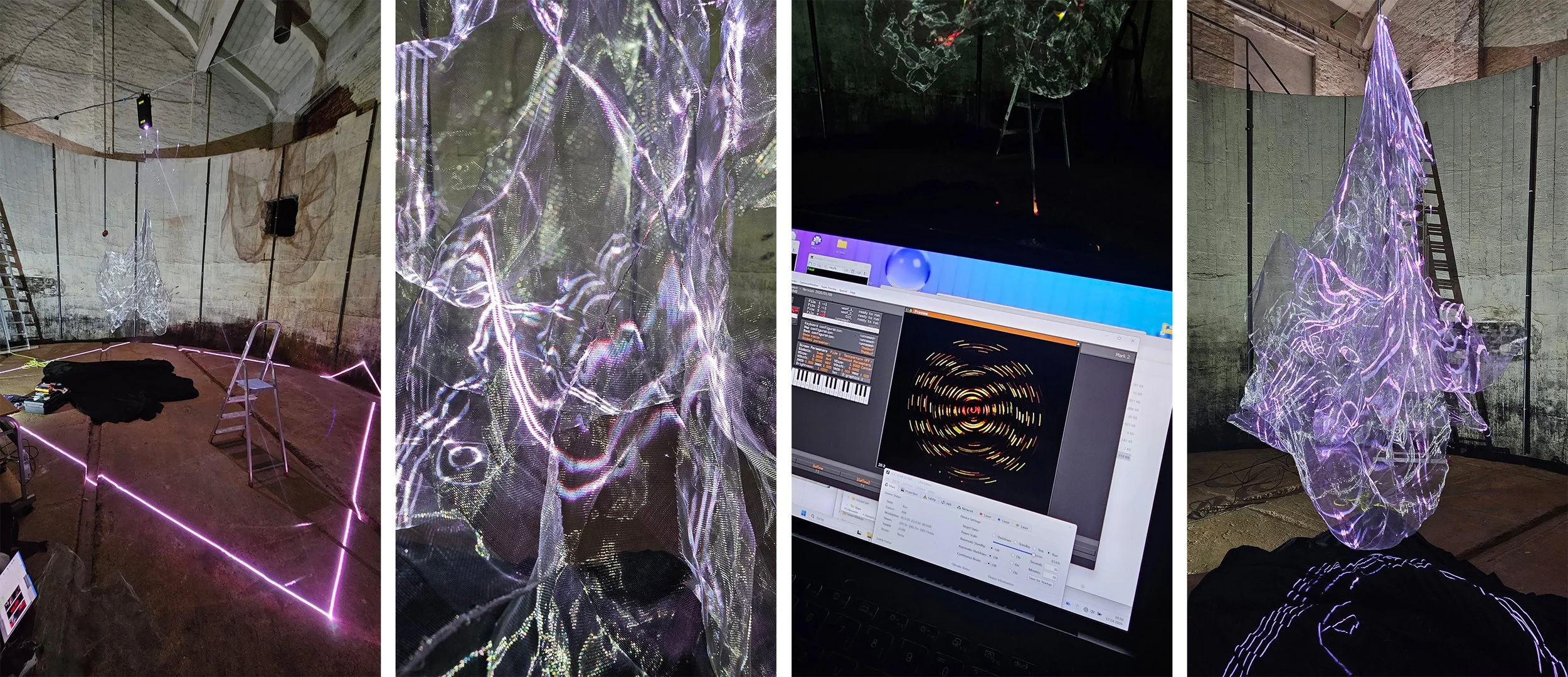
First tests of Noah’s Cloud in Monopol Berlin, April 2026
I first experimented with projection, curious to see what would happen when an image was projected into layers of semi-transparent material rather than onto a flat surface. The effect was fascinating: the image seemed to lose its surface and exist somewhere inside the mesh.
But projection was too dependent on darkness. Knowing the work would be shown in changing light conditions, I turned to laser — a much stronger light source, and a completely unknown field for me.
Laser technology is highly specialised and expensive, so I started looking for someone to collaborate with. This is how I met Michael Sollinger of LaserAnimation Sollinger, who generously offered his expertise, equipment and support in developing the work.
We began testing at Monopol Berlin. I returned several times, adding more material, changing the structure and learning what the laser could do inside it.
Only after I began to understand the possibilities of the medium did I start asking what it should show.
I needed something in constant movement. Something layered, changing and normally invisible.
That search led me to internet routing.
Julia Flit, Test of Noah’s Cloud, April 2026
What does the internet look like?
Once I knew what the laser could do inside the mesh, I needed to find something for it to carry.
I kept returning to the idea of invisible systems — processes that surround us and shape our lives, but have no physical form we can actually see. That was when I started looking at internet routing.
Every time we send a message, open an image or make a call, data travels through a network of connections. We experience the result almost instantly, but the journey itself remains invisible.
I started searching for ways to visualise this movement. This turned out to be much harder than I expected.
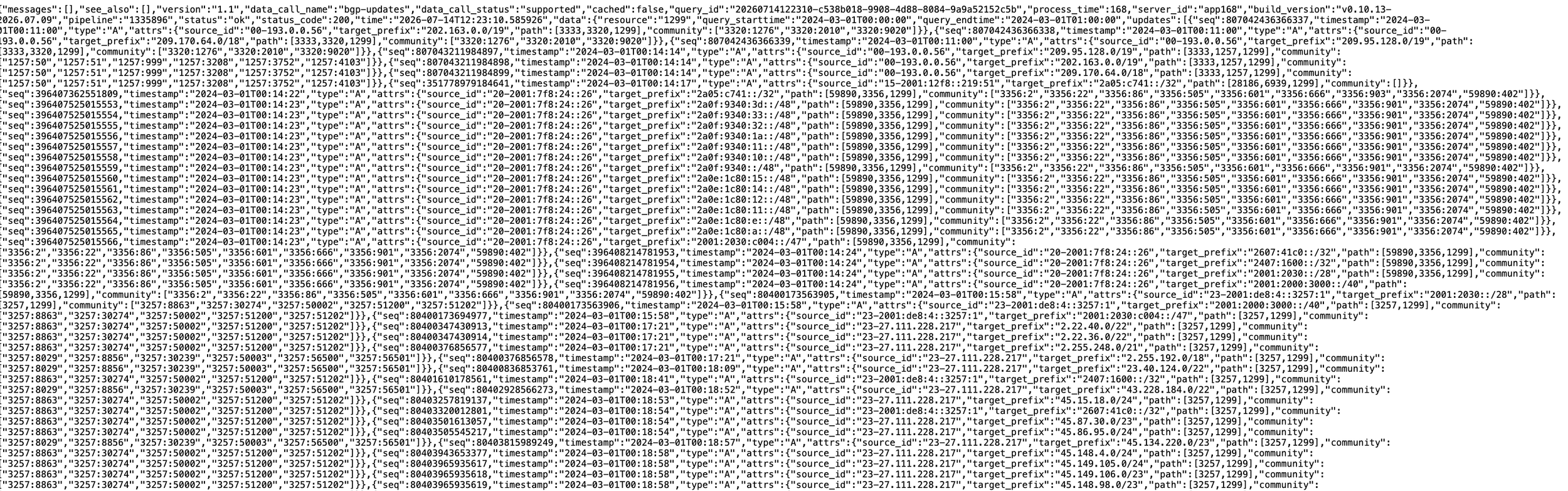
Raw BGP update data, one of the datasets I began working with.
Translating data into movement
Finding the data was one thing. Making it work with a laser was another.
It took me a few days to understand how the raw routing data could be translated visually. The real challenge came next: turning that visual logic into laser lines and teaching the code to behave the way I wanted.
There were many experiments. Some movements were too fast. Some transitions felt too mechanical. When there were too many points and lines, the laser began to flicker. I kept adjusting, simplifying and rewriting. Fewer points. Slower movement. Routes appearing and disappearing rather than simply moving across the surface. Gradually, the technical system started to behave more like the process I was trying to visualise.
After months of developing the installation, the data finally became part of the cloud.
Noah's Cloud
After months of testing, learning and rebuilding, Noah's Cloud finally came together in Berlin.
The work is based on internet routing data from March 2024, during a period of disruption to submarine communication cables in the Red Sea. I worked with routing activity involving two major global networks — Telia Carrier (AS1299) and Lumen Technologies (AS3356) — translating changes in network routes into lines and movement.
A laser carries this information through layers of suspended mesh. Routes form, disappear and reconnect. White lines represent the existing network; red enters as disruption intensifies and the system begins to adapt.
Noah's Cloud is not a literal map of the internet. It is a visual interpretation of how a network responds when its familiar paths are interrupted.
We rarely think about the physical infrastructure behind our digital lives. We send a message and expect it to arrive. But behind that simple action is a constantly changing system, searching for routes, redirecting information and adapting to disruption.
What began with a piece of mesh and an experiment with light became a way of giving physical form to this invisible process.
To make the invisible visible.